

Remember Flock? LAPD Just Dropped Them Over Privacy and Civil Liberties Concerns
Flock's license plate cameras track millions of innocent drivers nationwide, and LAPD just said the privacy risk isn't worth it.

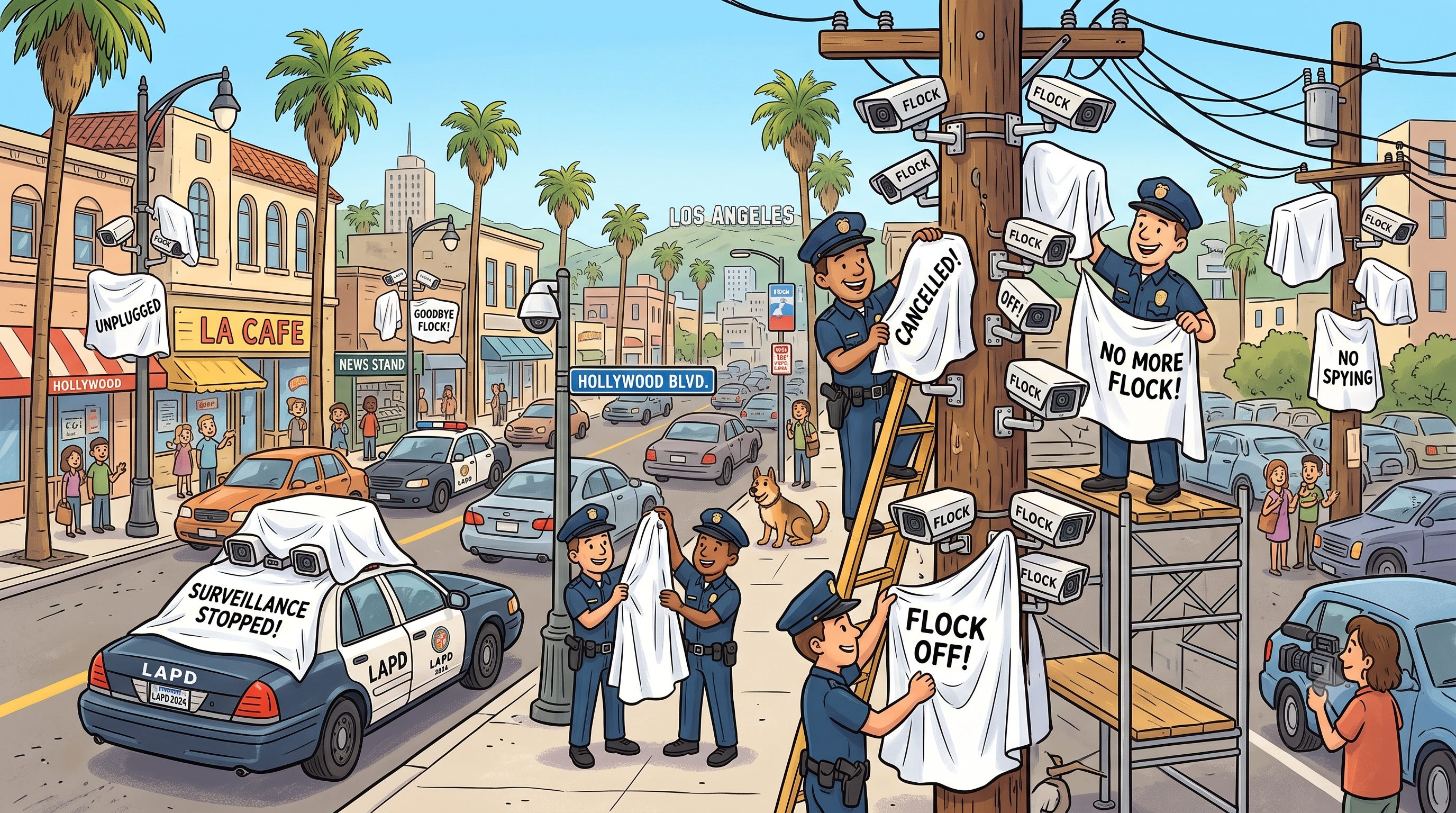
I’ve written about Flock’s license plate cameras before and wanted to flag a big update that's a step in the right direction. The LAPD (aka Los Angeles Police), the third-largest police department in the country, just let its contract with Flock Safety expire. According to TechCrunch, LAPD’s chief information officer Dean Gialamas said the contract wasn’t renewed because of “serious concerns around civil liberties and civil rights issues, particularly around privacy and the data that is being collected from these cameras.”
What is Flock?
Flock (officially Flock Group Inc.) is the company behind most of the automated license plate readers (ALPRs) you’re driving past every day, whether you notice them or not. These are AI-powered cameras that read every license plate that passes, and log your car’s location, date, time, make, model, color, and identifying features like dents or bumper stickers.
I covered this in detail in my post Your Car Is Being Tracked: Meet Flock, which you should check out. The short version is that Flock has built a nationwide vehicle-tracking network by sharing data among thousands of police agencies, and the company itself doesn’t control what any individual agency does with the data it collects. That means there’s no centralized way to find out where your information ended up or to get it deleted.

This means that you can be tracked by where you drive using this system. It tracks everything it sees, not just criminals, and not just people who have broken the law. It’s a huge privacy exposure with lots of implications for abuse, which we are seeing (more on that later).
Why LAPD’s decision is a big deal
LAPD is one of Flock’s largest government customers in the country. When a department this size walks away, citing civil liberties concerns by name, that’s a significant signal, and hopefully other cities will take a hard look at their contracts with Flock as well. It’s not the first city to do this. Mountain View, California, and South Portland, Maine, have also cut ties with Flock, both citing privacy concerns and, in South Portland’s case, concerns that federal immigration officials used the cameras to track people in violation of the city’s own sanctuary policies.
These aren’t hypothetical risks; these are actual risks associated with Flock. The TechCrunch piece lays out a pretty ugly track record:
Researchers have documented a growing number of cases of innocent drivers being pulled over, detained at gunpoint, or jailed because of false positives and errors in the license plate matching.
A journalist at The Drive was tracked for days and boxed in by police after a Flock camera wrongly flagged the car’s plate as stolen.
404 Media found Flock cameras exposed to the open Internet, allowing reporters to watch themselves live through cameras that were never supposed to be public.
The DEA reportedly used a local police officer’s login, without that officer’s knowledge, to search Flock’s system for someone accused of an immigration violation. Many police logins for the system still aren’t protected with MFA (multi-factor authentication). https://techcrunch.com/2025/11/03/lawmakers-say-stolen-police-logins-are-exposing-flock-surveillance-cameras-to-hackers/
This is a surveillance system with 80,000+ cameras, storing data on where you go, and the security protecting who can search it has been sloppy enough that a federal agency could quietly reuse someone else’s credentials.
What you can do
Unfortunately, if you drive a car, there isn’t a personal setting you can flip to opt out of ALPR cameras. But you can get informed and get involved:
Check if you’ve been “flocked.” haveibeenflocked.com lets you search released audit logs to see if your plate has shown up in a Flock search. It’s an incomplete dataset (most agencies don’t make it easy to find), but it’s a start.
See what’s deployed near you. deflock.me/map maps known Flock camera locations by city. eyesonflock.com tracks aggregated usage stats. The EFF’s Atlas of Surveillance goes even further, mapping ALPRs alongside drones, face recognition, and other surveillance tech by city and county (I’ve also written about this resource, worth checking out if you want to see what your local department has bought).

Support the organizations doing the legwork. plateprivacy.com advocates specifically against ALPR mass surveillance. The EFF monitors this space and regularly litigates against it.
Push for transparency locally. LAPD, Mountain View, and South Portland didn’t drop Flock because the company had a change of heart. They dropped it because of public pressure and local advocacy. If you want your city to reconsider its contract, showing up to a city council meeting matters more than you’d think.
Stay Safe!
Tate
I would be eager to upvote this, if not for the gross GenAI graphics... your content feels meaningful, but I don't know why I could trust it given the AI slop.
My thoughts exactly. The temptation to damage them and get caught would be on my record perhaps longer than these cameras.
I wasted too much time planning an attack. Think of the irony of putting your phone in a RFD Faraday bag, dawning a inferred suit and putting an aluminum bag over the camera so it can't transmit, disconnect the unit in a snow storm.
But wait there's more! I would take all the cameras to the top of a mountain range and set them up looking at wildlife! Untie the aluminum bags and let the wind blow them off. After I had left. Sounds like fun!